There remains some confusion both here and in the Philippines regarding Consularization of Documents, Red Ribbons and Apostilles. The Philippines joined the Apostille Convention in May of 2019. This Convention means that instead of having a document signed and notarized, and then sent or carried to a Philippine consular location, the document may be sent or carried to the Secretary of State’s office where the document was signed (In Colorado you can do the Apostille through the Secretary of State by mail) The Secretary of State then does an apostille of the document. Basically, an apostille is a verification of the notary’s signature (notarizing the notary if you will). Once you receive the Apostille, the document can be forwarded to the Philippines.
RED RIBBONS: prior to May of 2019, authenticating a document by any consular official involved not only a fancy cover sheet and a seal but a placing a red ribbon on the document as well. Placing the red ribbon was a headache and as part of the Apostille convention changes, the DFA did away with the red ribbon requirement. People may still refer to the process as a red ribbon but we do not do that any more. If you are told to get a red ribbon for a document, securing an Apostille accomplishes the same goal.
While there are a couple of steps needed to get an Apostille from the Secretary of State, doing this process by mail certainly beats driving many hours to have this office do it in person. In an effort to make the apostille process work for you we do provide the following information (1. Apostille acceptance, 2. Secretaries of State, 3. Special Note on having the form prepared in the Philippines, 4 Notary issues – read them all):
- Despite the fact that the Philippines joined the Apostille Convention 5 years ago, there are many in the Philippines who are not aware of the change. The Department of Foreign Affairs attempts to address this through this website: DFA Apostille Website
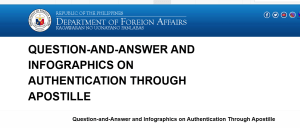
This page references both getting Apostilles for documents both in the Philippines as well as apostilles for US documents to be used in the Philippines. Paragraphs 8 & 9 specifically reference overseas documents:
8. I am an Overseas Filipino, how will the Apostille Convention affect me?
Just as Philippine documents for use in Apostille countries will no longer need to pass through another authentication by the foreign embassies in Manila after they have been authenticated (Apostillized) by the DFA-OCA, foreign documents from Apostille countries will only need Apostillization by the host government for them to be validly used in the Philippines or in another Apostille country. (Note: DFA-OCA will not authenticate/Apostillize all types of foreign documents.)
There shall be no change in the authentication process in non-Apostille countries and in Austria, Finland. Germany and Greece.
9. What if I still want my document, executed in an Apostille country, to be authenticated by the Philippine Embassy?
By 14 May 2019, Philippine Embassies/Consulates shall no longer authenticate documents originating from Apostille countries. Such documents will still need the Apostille from the host government but not the authentication by the Philippine Embassy/Consulate.
Embassies and Consulates are not authorized to issue an Apostille. However, Philippine Embassies/Consulates shall continue to provide acknowledgement and jurat services to walk-in applicants regardless of whether the origin of the document is an Apostille country or not.
It is our hope that by referring any Philippine government official or other person processing your documents to this page, they will accept your properly Apostilled document. If you encounter a continuing issue with a local official refusing to accept an apostilled document, please contact us with the specifics (email in particular) of the individual not accepting the form, we will relay the information to the San Francisco Consulate, they have indicated a willingness to contact the person and discuss the new procedure.
2. Secretaries of State and Securing Apostille
We are most familiar with Colorado’s Apostille process which can be found here: Colorado Secretary of State: Apostilles. They offer both walk in Service (Downtown Denver) or by mail. The forms and everything you need can be found at the above link. See the note on SPA’s and notaries below.
Wyoming’s process is similar but not the same. Wyoming Secretary of State: Apostilles. Note that walk ins are by appointment only.
We know that there may be some administrative headaches associated with getting an apostille through the Secretary of State but working through those seems way better than driving for hours and hours to our office.
3. SPECIAL NOTE: While you can do many forms by yourself, we do urge you in the strongest possible terms to please have your contacts or attorney in the Philippines prepare any legal documents such as an SPA that you wish to have Apostilled here for use in the Philippines. Our office cannot help fill out your SPA or other form. We cannot know or understand what you are trying to accomplish. Further, we cannot know what the official in the Philippines wants or is demanding so avoid wasted time and money, get them to send a form they want you to sign.
4. SPAs and Notaries: In order to secure an apostille, the document itself has to be signed by you and then notarized. The standard Special Power of Attorney form provided by the Foreign Service and made available through the San Francisco Consulate’s website does not actually have the notary block on it. So if you fill it out, sign and have witnesses sign, the Secretary of State cannot apostille that document. We have modified their form to include the Colorado Notary block: sample.
Sorry if this is a bit confusing, but working your way through it may save you hours of needless driving and other travel expenses.
 Philippine Honorary Consulate Colorado